What size hail damages cars?
The damage scales with size, but not in a straight line. Dime-size hail is mostly a non-event. Nickel starts causing trouble. Quarter-size is definite trouble, and half-dollar and larger is serious. Size alone does not tell the whole story, though — wind speed, the angle of impact, your vehicle's metal, and how it was parked all change the outcome. Here is the full picture, threshold by threshold.
Inspected and repaired by hand at our Olathe shop · 23 years and 5,000+ vehicles · lifetime warranty in writing.

What does each hail size do to your vehicle?
The same storm can leave a parking-lot dimple on one car and a five-figure repair on another. Here is what to expect at each size.
Key takeaways
- Pea and dime-size: mostly minor. Often below a typical $500 deductible on a lightly exposed car.
- Nickel-size, seven-eighths of an inch: claims start here. Damage usually clears a typical deductible.
- Quarter-size, one inch: serious. Nearly every exposed vehicle takes repair-worthy damage.
- Golf-ball-size and up: glass damage joins denting — and some vehicles approach the total-loss threshold.
- Size isn't the whole story. Wind speed, impact angle, the panel's metal, and how you parked all change the outcome.
Pea-size, about a quarter inch — rarely damaging
Pea-size hail bounces off most modern painted metal without leaving a mark. The energy at this size is simply too low to deform automotive-grade steel or aluminum. An older car with thinner paint and softer metal can show the occasional micro-dent that only an LED line board reveals, but for the vast majority of vehicles, pea-size hail comes and goes without a claim.
Dime-size, three-quarters of an inch — occasional light damage
Dime-size hail is common in lighter Kansas City storms, and it is the first size where damage becomes possible. Sustained bombardment can leave shallow dents on the horizontal panels — hood, roof, and trunk lid — where the stones land square. The dents tend to be small and spaced apart, and the vertical panels usually escape unless wind drives the hail sideways.
If the damage adds up, a full-vehicle paintless dent repair typically runs $1,200 to $2,500. The catch is that dime-size damage often lands below a common $500 deductible, so on a lightly exposed car it may not be worth filing. A vehicle parked outside for the whole storm can accumulate enough to clear that line.
Nickel-size, seven-eighths of an inch — regular damage territory
This is where claims start to matter. Nickel-size hail carries enough mass and speed to leave clear dents on the horizontal panels and — in a wind-driven storm — on the side facing the weather. The dents come deeper, closer together, and more numerous than dime-size marks, and on most exposed vehicles the total clears a typical deductible.
You will see dents on the hood and roof that catch the light at certain angles. Under an LED line board, the picture is worse: the board commonly reveals two to three times the dents a daylight look turns up. A full-vehicle repair usually falls between $1,800 and $4,000 and takes one to three days, and most owners file at this level.
Quarter-size, one inch — serious damage
At quarter-size, nearly every exposed vehicle takes repair-worthy damage. This is where hail crosses from "might need repair" to "definitely needs repair." The horizontal panels fill with dents, the storm-facing side is heavily hit, and even partly sheltered cars — under a carport, beside a building — usually take some damage on the exposed surfaces.
The dents are visible from several feet away on flat panels; hoods and roofs show obvious patterning. Under a line board the count climbs sharply — panels that look lightly marked in daylight often hold 50 to 100 dents apiece. A full-vehicle repair generally runs $3,500 to $7,000 and takes two to four days. Supplements are common here, because a photo-based or parking-lot inspection routinely undercounts the real damage.
Half-dollar-size, one and a quarter inches — severe damage
Half-dollar hail spreads damage across every panel on the vehicle. The horizontal surfaces fill in densely, and the vertical panels on all sides take dents because stones this size carry enough energy to mark metal even at an oblique angle. Oversized-dent line items start stacking in the estimate, which raises the per-dent cost.
The damage is obvious from across a parking lot — hoods and roofs look textured, and body lines on the doors and fenders distort. Windshields are at risk, especially on the windward side. A full repair usually lands between $5,000 and $9,000 over three to five days, and some lower-value vehicles begin approaching the total-loss threshold depending on their actual cash value. Severe hail damage service details.
Golf-ball-size, one and three-quarter inches — very severe
Golf-ball hail introduces glass damage on top of dense denting. At this size, stones crack windshields, shatter sunroofs, and leave dents deep enough to stretch the metal. Some of those dents exceed what paintless dent repair can correct and call for panel replacement, particularly along crease lines and sharp contours where the metal is already under tension.
The damage is dramatic from any angle: hoods and roofs can look hammered, contours distort, and windshield cracks are common. A full repair typically runs $8,000 to $13,000, and some vehicles get flagged for total-loss review depending on age and value. The threshold is 75% of actual cash value in Kansas (K.S.A. 8-197(b)(2)(B)) and 80% in Missouri (RSMo 301.010(55)(a)). On a $20,000 car in Kansas, that line sits at $15,000 — and golf-ball hail on a fully exposed vehicle can approach it. Total loss guide.
Tennis-ball-size, two and a half inches — catastrophic
Tennis-ball hail pushes many vehicles past the total-loss line. Windshields shatter, sheet metal stretches beyond paintless dent repair limits in multiple spots, and panel replacement becomes necessary on some surfaces. The damage is immediate and often shocking. Repairs commonly run $12,000 to $18,000 or more, and total-loss declarations are frequent, especially on vehicles older than five or six years. Even newer, higher-value cars can reach the threshold once glass and panel-replacement line items join the estimate.
Baseball-size, two and three-quarter inches and up — extreme
Rare in the Kansas City market, but possible. At this size, total-loss declarations are common regardless of a vehicle's age or value. Structural damage can occur — roof supports, A-pillars, and frame rails are all in play — and windshields, sunroofs, and sometimes side windows give way. A vehicle caught in baseball-size hail may not be economically repairable at all.
Why do the hood, roof, and trunk take the worst of it?
The panels that face the sky take the full force of every stone. The rest depends on the wind.

Your hood, roof, and trunk lid are the most vulnerable surfaces because they face straight up. In a storm with little wind, those horizontal panels catch the full perpendicular impact of every hailstone, while the vertical panels — doors, fenders, quarter panels — only take damage when wind drives the hail sideways.
The geometry also shapes the repair bill. Horizontal panels are usually the largest on the vehicle and the easiest to reach for paintless dent repair: a technician can work the back of a hood directly. A dent on a door or quarter panel may mean removing interior trim or a window regulator to reach the backside — remove-and-install work that adds line items to the estimate.
Flat surfaces also show dents more readily than curved ones. A dent that would hide on a curved fender stands out on a flat hood. That cuts both ways: the damage is easier to find and document for the claim, and it is also more visible to you every time you walk up to the car.
How does your vehicle's metal change the damage?
Two cars in the same storm can fare very differently depending on what their panels are made of.
Not every vehicle responds the same way to the same storm. The body-panel material decides how the metal deforms, how deep the dents go, and how the repair gets done.
Mild steel is the most common, and it repairs well. Standard automotive steel has good elasticity — it deforms under impact but keeps enough structure for paintless dent repair to push the dents back to shape. Most cars on the road are predominantly mild steel, and the method works across the full range of hail sizes, right up to the point where the metal is stretched past its elastic limit.
High-strength and ultra-high-strength steel are harder both ways. Increasingly common in newer vehicles, this steel resists denting in the first place — which is good — but also resists returning to shape once dented, which is not. The same strength that prevented the dent fights the repair, so the work takes more time, more precise technique, and sometimes heat assistance.
Aluminum behaves differently again. Used heavily on the Ford F-150, Tesla Model 3 and Model Y, and many luxury cars, aluminum deforms more readily on impact and does not spring back like steel, so a given stone leaves a sharper, deeper dent. Repair calls for glue-pull methods, heat-assisted technique, and careful pressure to avoid cracking the panel, and most insurers approve roughly a 25% markup. Aluminum hail repair details.
Composite and plastic panels flex instead of denting. Some bumpers and specialty body panels are reinforced plastic; hail may bounce off without a mark, or it may crack the panel outright. Paintless dent repair does not apply to these surfaces.
Why do identical hail sizes produce different damage?
A stone driven sideways by the wind hits far harder than the same stone falling straight down.
A one-inch hailstone falling straight down hits with far less energy than the same stone driven sideways by a 60-mile-an-hour gust. Wind speed and impact angle are the two most underappreciated variables in hail damage, and they explain why two storms both reporting "quarter-size hail" can leave very different cars behind.
Terminal velocity sets the floor. A one-inch stone falling through still air tops out around 45 miles an hour — the minimum speed it can hit at. Perfectly calm hailstorms are rare in Kansas City, though; most hail falls inside severe thunderstorms carrying real wind.
Wind stacks onto that speed. Add a 50-mile-an-hour surface wind to that 45-mile-an-hour fall and the stone can strike well above 60. Because kinetic energy climbs with the square of velocity, doubling the speed quadruples the impact — which is how wind-driven dime-size hail sometimes outdoes calm quarter-size hail.
Angle decides which panels get hit. In calm air, only the horizontal panels are at risk. As the wind rises, the impact tilts toward horizontal, and at a 45-degree angle the doors and fenders take nearly as much as the roof. In extreme wind, the storm-facing side can end up worse than the roof.
That is why how you were parked matters. Nose-into a typical Kansas City storm, the hood and front fenders take the brunt. Parked broadside, one entire side — every door, fender, and quarter panel — absorbs full impact while the other side may come through nearly clean.
How do you inspect your vehicle after a storm?
You can do a useful first pass yourself — just know you will only catch a fraction of the real damage.
A self-inspection is worth doing, as long as you understand its limits. Here is how to look, by hail size.
After dime to nickel-size hail, start with the horizontal panels. Stand at the front and sight down the hood at a low angle — dents read as faint shadows or light distortions. Do the same across the roof from each side, then check the trunk lid. In daylight you may find 20 to 40% of the actual damage; the rest waits for a line board.
After quarter to half-dollar-size hail, the damage should be visible standing up. Walk the whole vehicle, check every panel, and look at the windshield and rear glass for cracks or chips. Inspect the plastic trim — mirrors, door handles, antenna housing — for cracks, and photograph everything. Full documentation guide.
After golf-ball-size and larger, the damage will be obvious, so focus on the things that change your next move: the glass (windshield, rear window, sunroof, side windows), the panel integrity (sharp creases or stretched metal that may be past paintless dent repair), and any fluid leaks under the hood. Document with photos and video before moving the vehicle if you safely can.
Why can't you judge hail damage by eye alone?
An LED line board surfaces the damage a daylight look — and a first estimate — almost always misses.
An LED line board reveals well over half of hail damage that is effectively invisible in ordinary light. That is not a sales line — it is the reason parking-lot inspections and phone-photo estimates consistently undercount what is really there.
The board works by reflection. It is a large flat panel of evenly spaced LED strips; held near the bodywork, it casts a pattern of straight lines across the surface. Where the metal is true, the lines stay straight. Where there is a dent — even a fraction of a millimeter — the lines bend, and the eye catches the distortion instantly, including on dents too shallow to feel with a fingertip.
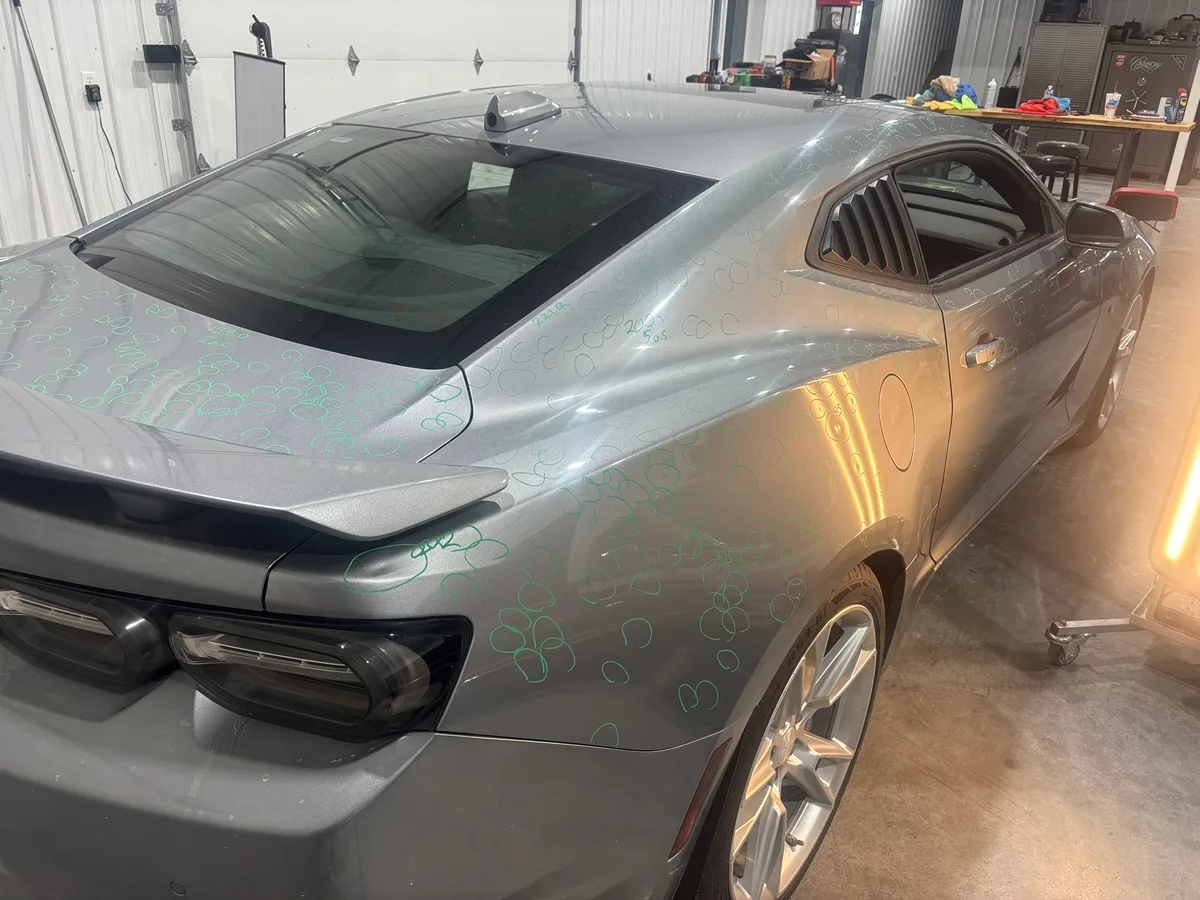
This is why the first estimate runs light. An adjuster working in a parking lot under ambient light finds the obvious dents and misses the shallow ones, the ones in curved areas, and the ones in shadow. When the vehicle reaches the shop and goes under the boards, the true extent emerges — and that is where the supplement process begins.
That gap is normal, not adversarial. Supplements are simply the standard way to capture damage the first inspection could not detect. A good shop documents every added dent under the board, photographs the evidence, and submits it in the format adjusters expect. You file the claim with your carrier; we never file it for you — but we give you the documentation that backs it up.
When does hail damage become worth filing?
The math is simple: if the repair cost clears your deductible, filing makes sense.
The most common comprehensive deductible in the Kansas City market is $500, and the decision turns on whether the repair clears it. Here is how that tends to break down by hail size.
- Dime-size, three-quarters of an inch: often $800 to $1,500 on a lightly exposed car. Against a $500 deductible, that is $300 to $1,000 of benefit — worth filing on a vehicle that sat out the whole storm, marginal on one with partial shelter.
- Nickel-size, seven-eighths of an inch: typically $1,800 to $4,000, leaving $1,300 to $3,500 after a $500 deductible. Almost always worth filing.
- Quarter-size, one inch, and up: $3,500 or more, far past any standard deductible. Filing is the clear call.
One important point about rates: hail damage is filed under comprehensive coverage, which insurers classify as an act-of-God event rather than an at-fault collision. Comprehensive claims generally do not move your rates, so in most cases a hail claim has no effect on your premium at renewal. Full rate-impact guide.
How do shops classify hail damage?
Once the vehicle is under the boards, the damage gets graded by dent count, dent size, and panel coverage.
A paintless dent repair shop sorts the damage into broad severity bands. The general industry categories run like this.
- Light: scattered dents, mostly on horizontal panels, fewer than 75 to 100 in total. Typical of dime to nickel-size hail on a partly exposed vehicle. Repair time: one to two days.
- Moderate: consistent coverage on the horizontal panels with some vertical damage, 100 to 200 dents. Typical of nickel to quarter-size hail on a fully exposed vehicle. Repair time: two to three days.
- Heavy: dense coverage on every panel, including vertical surfaces, 200 to 300 dents. Quarter to half-dollar-size hail, with oversized-dent surcharges beginning to apply. Repair time: three to five days.
- Severe: 300 or more dents across the whole vehicle, half-dollar and larger hail, multiple oversized dents and possible glass damage. May approach the total-loss threshold on lower-value vehicles. Repair time: five to seven days. Severe hail damage details.
What should you do once you know the hail size?
Above nickel-size, get a real look under line boards before you treat any estimate as final.
Anything nickel-size and up, get a professional inspection under LED line boards. At that size, damage is nearly certain on any exposed vehicle, even when you cannot make it out clearly from ten feet away. Below nickel, sight down your horizontal panels at a low angle in good light, and if you spot any distortion, it is worth a closer look.
Don't let a parking-lot glance or a quick phone photo decide whether you file. What you can see is a fraction of what is actually there. A 15-minute line board inspection at our Olathe shop gives you the full picture, and the inspection is free.
Let us read the real damage
Walk through the free claim tool to file with your carrier on your terms, or come by the Olathe shop for a 15-minute line board inspection. You file the claim; once it is approved, the repair is ours. Or call and ask for Bryan Wilson.
Common questions about hail size and damage
Is pea-size hail damaging?
Rarely, on a modern vehicle. At a quarter inch across, pea-size hail carries too little energy to deform automotive-grade steel or aluminum, so it usually bounces off without leaving a mark. An older car with thinner, softer paint can show faint micro-dents under controlled lighting, but for most drivers it is a non-event that never reaches a deductible.
What size hail causes insurance to respond?
Nickel-size — about seven-eighths of an inch — is where real claims start. Below that, many storms leave only cosmetic marks that fall short of a typical deductible. At quarter-size and above, nearly every exposed vehicle takes repair-worthy damage, and filing becomes the clear call. The repair runs under your comprehensive coverage, and you file the claim yourself — we never file it for you.
Can hail break a windshield?
Yes, once it passes golf-ball size, roughly an inch and three-quarters. Auto glass shrugs off stone strikes to a point, but a hailstone larger than 1.75 inches moving at sixty miles an hour or more can crack or shatter a windshield. Sunroofs are more fragile still — large hail breaks them regularly, which is one reason severe storms so often turn into glass claims alongside the dent repair.
Does aluminum dent differently than steel?
It does, and noticeably. Aluminum has different elasticity: it deforms more readily on impact and does not spring back the way steel does, so the same hailstone tends to leave sharper, deeper dents on an aluminum panel. Repair calls for specialized glue-pull work and heat-assisted paintless dent repair, and most insurers approve roughly a 25% markup on aluminum panels. A Tesla, a Ford F-150, or a luxury car with aluminum bodywork often shows far more damage than a steel-bodied car parked beside it in the same storm. Aluminum hail repair details.
Why can't I see all the hail damage on my car?
Because more than half of it is invisible to the eye in ordinary daylight. Hail dents are shallow — sometimes a fraction of a millimeter deep — and your eye cannot pick them out against the curved, reflective surface of a painted panel. An LED line board reflects even, controlled light across the panel so every dent, crease, and ripple shows up. That is why a quick parking-lot look routinely misses damage a shop finds under line boards, and why it pays to get a professional inspection before treating any estimate as final.
Is wind-driven hail worse than straight-down hail?
Considerably worse. Wind-driven hail strikes at an angle, so it dents the doors, fenders, and quarter panels that straight-down hail would miss. Wind also pushes a stone past its falling speed: a one-inch stone that hits at about 45 miles an hour on its own can arrive well above 60 in a strong gust, and impact energy climbs with the square of speed. That is why two storms reporting the same hail size can leave very different damage — the wind profile matters as much as the stone.